
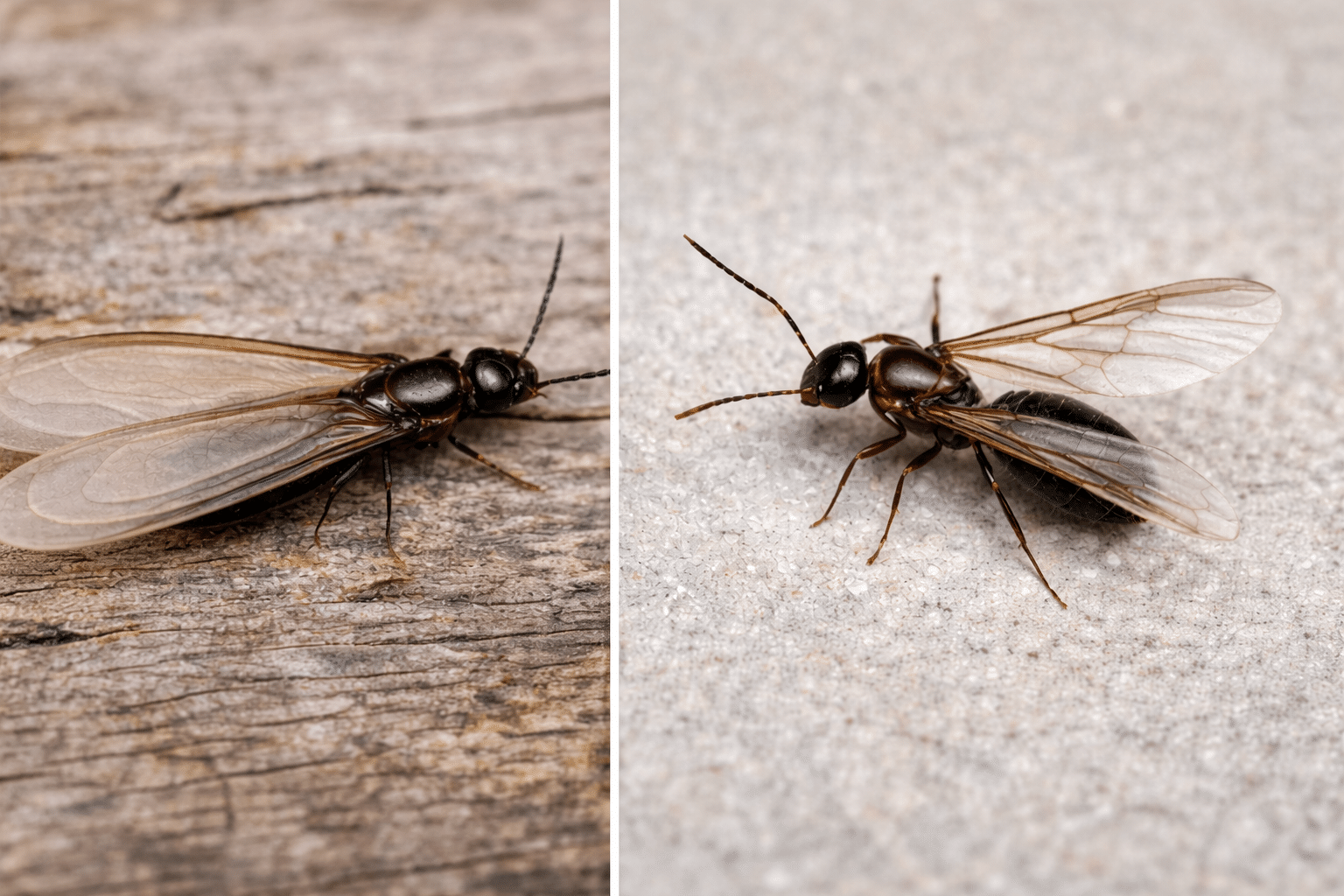
During spring in Maryland, it’s common for homeowners to notice small flying insects around windows, doors, or exterior walls. Two of the most commonly confused insects are flying ants and termite swarmers.
While they may appear similar at a glance, there are clear differences that help distinguish between the two.
Why These Insects Are Often Confused
Both flying ants and termite swarmers:
• Appear during warmer months
• Are attracted to light
• May gather near windows and doors
Because of these similarities, it’s easy to misidentify them without a closer look.
Key Physical Differences
The easiest way to tell them apart is by looking at their body structure.
Termite swarmers typically have:
• Straight antennae
• Equal length wings
• A uniform, straight body
Flying ants usually have:
• Elbowed antennae
• Uneven wing sizes
• A narrow, defined waist
These differences are visible when the insects are observed closely.
Wing Structure Comparison
Wings are one of the most noticeable distinctions.
• Termite swarmers have two pairs of wings that are equal in size
• Flying ants have front wings that are longer than the back wings
If wings are found on surfaces, their size and shape can help with identification.
Behavior and Movement
Behavior can also provide clues.
Termite swarmers:
• Tend to move slowly
• Often shed their wings after landing
• May appear in larger groups
Flying ants:
• Move more quickly
• Do not typically shed wings in the same way
• Are often seen individually or in smaller numbers
Where They Are Commonly Found
Location can help narrow down identification.
Termite swarmers are often found:
• Near foundation walls
• Around baseboards or interior walls
• Close to moisture-prone areas
Flying ants are more commonly seen:
• Outdoors near soil or landscaping
• Around exterior surfaces
• Occasionally indoors near entry points
What Their Presence May Indicate
Seeing either insect does not always mean there is a problem within the home, but it does provide useful information.
• Termite swarmers may indicate a nearby colony
• Flying ants may be associated with outdoor nesting activity
Correct identification helps determine whether further evaluation may be needed.
When to Consider an Inspection
If insects are seen indoors or in larger numbers, it may be helpful to schedule an inspection.
A termite inspection can:
• Identify signs of current or past activity
• Evaluate accessible areas of the home
• Provide clarity on next steps if needed
This helps avoid assumptions and provides a clear understanding of the situation.
Supporting Awareness During Spring
Spring is a common time for increased insect activity. Understanding the differences between flying ants and termite swarmers allows homeowners to respond appropriately.
Accurate identification helps ensure the right decisions are made without unnecessary concern.
Check out our reviews!

